The Wounaan and Their Baskets
The Wounaan
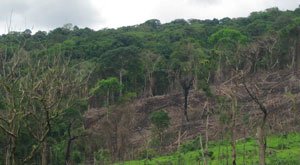
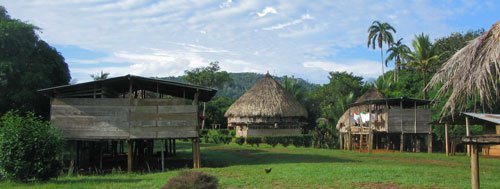
The Wounaan and Emberá Indians inhabit one of the world’s last untouched rainforests in Panamá. The Darién wilderness is mostly without roads or electricity. While the men hunt, fish, and farm, the women weave some of the technically finest and most beautiful baskets ever before seen. The purchase of this unique basket provides direct income to these remote indigenous tribes, enabling them to continue their traditional culture and to withstand the pressures of the encroaching modern world.
Processing Fiber
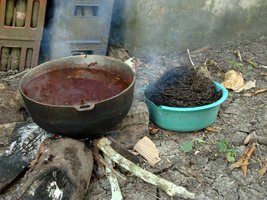
To weave a basket, the Wounaan need only two native plant fibers, and a modern sewing needle. However, to prepare these materials for use in weaving the baskets is a lengthy process. Before any weaving starts, the weaver must prepare the materials and dye enough threads to finish the basket. A big basket (~15 inch diameter or larger) can take 18 months to weave but it can take up to 3 months to prepare all materials.
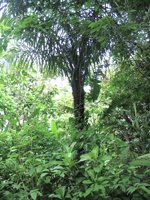
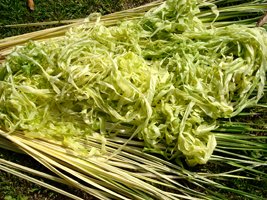
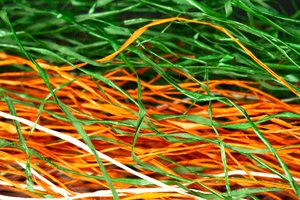
The “thread” fiber is obtained from wild Chunga palm leaves and colorfully dyed with extracts of plant leaves, bark and mud. First, the membrane part of the leaves is skinned off, and then roughly split into threads. The threads are then dried under the sun and cooked with plant juices in order to be to dyed to the correct color.
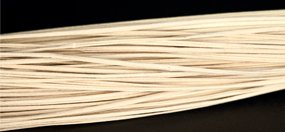
The “coil” fiber, called nahuala, is the same material used to make a Panama hat. A dried strain of nahuala fiber is as thick as a spagetti noodle. The weaver needs a bundle of nahuala to be the coil for the basket.
Weaving
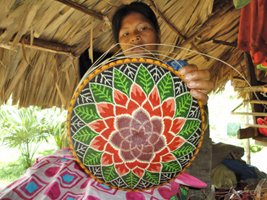
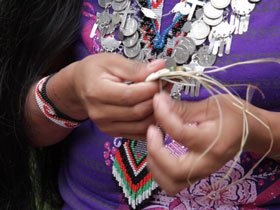
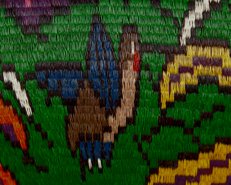
The weaver starts a basket by tying a knot with a bundle of nahuala fibers. She stitches around the knot with a needle and Chunga thread to create the bottom center of the basket. As she coils the bundles around the knot, she secures the coil by sewing the thread around the coil to a stitch of the previous coil. She continues this spiraling and stitching technique to create the basket. By using different colors of thread she creates a design on the basket.
Cultural Styles
The earliest baskets were black and white. Designs were borrowed from the body painting images and geometric patterns used in ceremonial dance. These body paintings, applied with dye derived from Jagua fruit, are believed to protect the wearer from bad spirits, and may also protect also protect the skin from sunburn and repel mosquitos. As the Wounaan learned how to dye the palm leaves with more plants and bark, the colorful cultural patterns were incorporated into baskets.
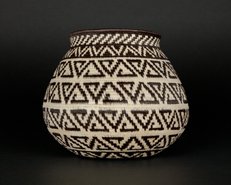
Artist Unknown
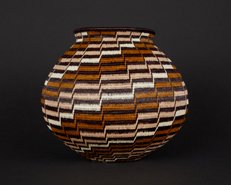
Artist Unknown
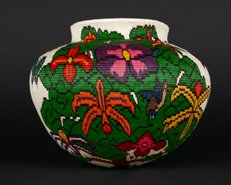
By Seibet Cheucarama
Technical Skill
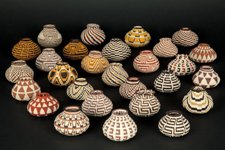
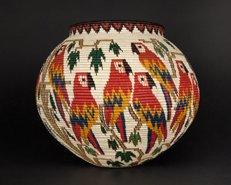
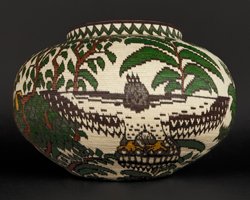
While the Wounaan have advanced their technical skills at weaving finer baskets, they have also developed their artistic skills to weave more complex rainforest designs such as flowers, hummingbirds, butterflies, parrots, toucans, jaguar tracks and bats. Some master weavers weave large non-repetitive jungle scene baskets that can take a year or two to complete. Some just weave miniatures.
In general, you will find higher stitch count in smaller baskets. A big basket stitch count is typically 300 to 400 stitches per square inch, while smaller baskets may have stitch counts in the 600 to 1000 stitches per inch range. To achieve a finer or higher stitch count basket, the weaver not only splits the thread thinner but also uses a smaller bundle of nahuala fibers.
Stitching Techniques
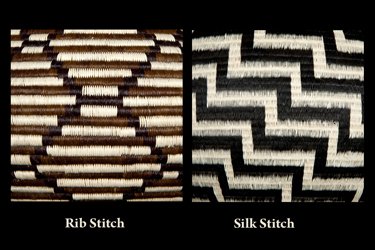
There are also two types of stitches: rib or silk. To create a rib stitch, the needle goes through the top of the coil. The silk stitch is produced by putting the needle in the middle of the coil. As a result, the rib stitches show a distinct ridge on the basket. If you touch a rib stitched basket, you will feel the coils vs a smooth feel in a silk stitched basket. Weavers and collectors have no special preferences on one over the other.
Collections - Details Regarding the Rise of Wounaan Basket Sales
- Transition to market: While traditional, utilitarian baskets were made for centuries, the refined coiling technique using chunga palm fiber gained traction for commercial sales in the 1970’s and 1980’s.
- Artistic Evolution: The intricate pictorial and colorful “lifelike” designs showing flora and fauna were popularized in the 1980’s, building upon the traditional black and white, geometric body painting patterns.
- Key influences: Development and interaction with outside visitors in the 1980’s helped turn this art form into a significant source of income for Wounaan and Embera Women.
- Recognition: These baskets are now highly regarded, with some collectors identifying them as the finest contemporary baskets in the World according to the Bowers Museum.
Environmental Impact
The Wounaan are a small, rural group that relies heavily on the forest for their livelihoods. The forest provides food, shelter, and habitat for the Wounaan and their indigenous people. The forest also plays a crucial role in the ecosystem. If you are concerned about the forest, you can help by supporting local businesses, volunteering, or donating to a local organization. If you would like to help or to know more, please contact Native Future.